
Building vs. Buying SaaS: A Practical Comparison
I’d build SaaS when control over the product justifies the cost - and license it when existing features and license compliance and contract rights meet your needs. Before choosing, I’d compare the same workflows, user count, and five-year budget.
In this article’s hypothetical example, building costs $1,685,000 over five years versus $1,105,000 for licensing - about 34% less. Those figures aren’t market benchmarks. Your staffing, usage, integrations, and exit plans can change the result.
Here’s what I’d check before funding development or signing a deal:
- Product fit: Workflows, customization, branding, and launch timing.
- Costs: Setup, staffing, hosting, fees, maintenance, support, growth, and exit.
- Responsibilities: Deployment, testing, security, compliance, updates, and scaling.
- Rights: Code and data ownership, resale, modifications, transfer, and export.
Quick Comparison
| Criteria | Build custom SaaS | Buy or license SaaS |
|---|---|---|
| Control and customization | Set your roadmap and product design | Work within vendor features and contract limits |
| Launch and staffing | More development work; requires technical leadership | Usually sooner; still requires setup and administration |
| Hosting, security, and scaling | Your team runs and maintains the product | Vendor handles the platform; your team still has duties |
| Integrations, updates, and support | Build, maintain, and fund them | Check API limits, fees, update policies, and support terms |
| Ownership and resale | Secure written code and IP rights | Confirm branding, resale, and modification rights |
| Five-year cost | Development plus upkeep and exit | Implementation plus fees, usage, administration, and exit |
| Leaving or switching | Requires documentation and handover | Requires export rights and a migration plan |
My starting rule: <u>test the hardest workflow and data export before committing</u>. If you license a core product and build integrations around it, confirm you can reuse that work after switching providers.
Buy Software or Build It? The 4-Step Framework That Prevents Costly Mistakes
sbb-itb-8650f75
Building Custom SaaS
When control matters more than speed, building gives you ownership of the product and its technology stack. It also puts delivery, security, and upkeep on your team.
Control, Customization, and Code Ownership
Build only when proprietary workflows, pricing, or data structures give you a clear advantage. Before coding, define tenancy, access, hosting, backups, and disaster recovery.
Paying developers doesn't automatically transfer ownership. Employee-created code generally belongs to the employer. With contractors, use a written IP assignment that covers deliverables, pre-existing materials, repo access, and post-contract cooperation. Track open-source license terms, too. Without clear rights, you may own the liability without owning the asset.[3][4][6][7]
| Control gained through building | Cost, delay, or responsibility |
|---|---|
| Tailored workflows and UX | Discovery, design, usability testing, and revisions before release |
| Roadmap and release priorities | Product-management overhead and continued development capacity |
| Hosting and data architecture | Infrastructure bills, data isolation, backup testing, and recovery planning |
| Custom integrations | API limits, authentication changes, retries, and failure monitoring |
Each choice affects the work required to launch, support, and eventually exit the product.
Development and Maintenance Duties
Start with discovery and measurable requirements. Then define the architecture and build in small, testable increments. Check integration limits and failure handling early.
Testing should cover units, integrations, end-to-end flows, accessibility, security, and performance. Use automated deployment, staged releases, and tested rollback procedures - not a series of manual deployment steps.
Give each technical-debt item an owner and a risk rating. At least two people should be able to deploy and handle incidents, with runbooks, code review, and secure credential management to support them. After launch, assign owners for monitoring, backups, patching, incident response, documentation, and support.
Budget for these duties before funding starts.
What You Need Before Building
Before funding development, approve a product brief that states what's excluded, identifies required integrations, and defines three to five core MVP capabilities.[9] Set measurable acceptance criteria for expected traffic, response times, recovery targets, and data exports.
Secure technical leadership and funding for both development and post-launch operations. Set milestone gates for an end-to-end slice, MVP, beta, and launch. Require successful backup restoration, tested rollback, and no unresolved critical security defects. Plan privacy, compliance, and peak-load testing before setting a launch date.[5][8]
Buying or Licensing Existing SaaS
Buying SaaS usually gives you rights to use the software - not ownership of its IP. The contract determines your branding, resale, modification, and exit rights.[11][13][17]
| Arrangement | Branding | Resale or sublicensing | Modification | Hosting and maintenance | Ownership |
|---|---|---|---|---|---|
| Subscription access | Usually provider-branded; custom domains and limited branding may be available | Usually prohibited unless expressly allowed | Configuration and integrations | Usually managed by the provider under the service agreement | Provider retains software IP; customer typically owns or controls its data |
| Commercial license | Depends on the license | Deployment, resale, and sublicensing rights have defined limits | Code changes may require separate rights | Provider, customer, or shared, depending on deployment | Provider usually retains core IP |
| White-label rights | Buyer’s brand, logo, domain, and customer-facing materials | Often allowed, subject to territory, customer, and volume limits | Branding and configuration; deeper changes require approval | Hosting, updates, uptime, and support duties must be assigned | Provider retains platform IP; buyer receives branding and distribution rights |
| Source-code access or license | Subject to trademark and third-party restrictions | Only as expressly granted | Broader rights, subject to dependency licenses and reserved components | Usually managed by the buyer unless support is purchased | Code access or a license, not necessarily exclusive IP ownership |
Launching sooner shifts some of the work from engineering to reviewing contract terms and vendor limits.
Launch Time and Vendor Limits
Existing features reduce initial engineering work and can help you launch sooner. But configuration, migration, security review, integrations, and contract negotiations can still cause delays. Check API limits, pricing, support, uptime, update frequency, and who handles hosting.[20][21][22]
Branding, Resale, and Exit Rights
After launch, the contract controls what you can brand, transfer, or resell. Confirm territory restrictions, revenue sharing or other recurring charges, minimum commitments, and transfer rights if you later sell the business. Spell out who owns customer data, custom code, and improvements - and whether the provider can reuse them. Don't promise customers more than the provider commits to deliver.[12][18][22]
Have counsel review security duties, audit rights, liability and indemnity, termination, and obligations for moving customers to another service. Specify export formats, such as CSV or JSON, along with included metadata and configuration details, access deadlines, migration fees, and deletion requirements. For source-code access or escrow, define deliverables, verification, update frequency, release triggers, and rights to run the software after release.[13][14][15][16][22]
Review Licensing Deals Through LicenseSaaS
Before signing, check the legal and technical terms that govern deployment and support. Use the deal room to compare terms, confirm the seller’s authority, and verify the license scope and dependencies. Review escrow, deployment, and support terms before paying.[10][19]
Comparing 5-Year Costs and Team Responsibilities
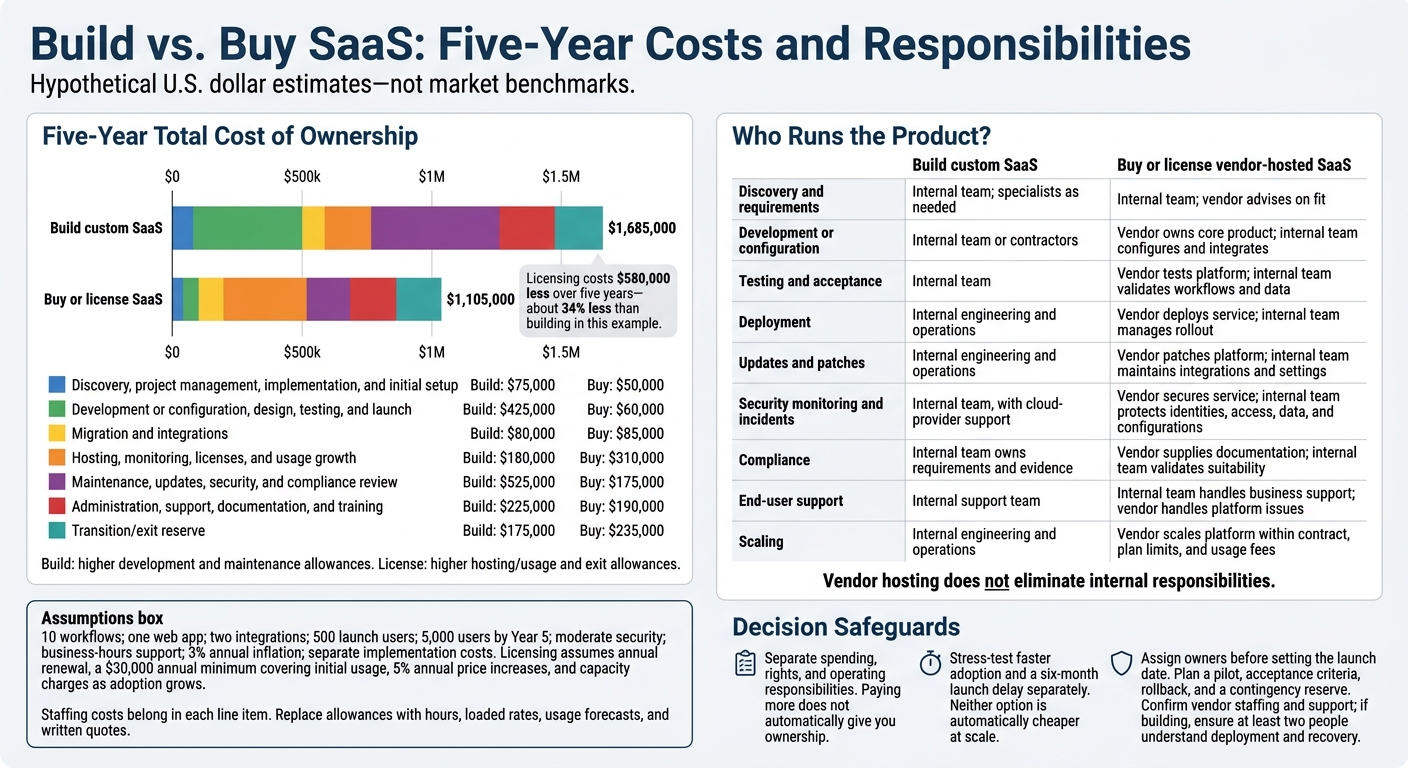
Build vs. Buy SaaS: Five-Year Costs and Responsibilities
Compare total cost of ownership, not a development quote against a subscription price. Separate three questions: what you'll spend, what rights you'll receive, and who will run the product. Paying more doesn't automatically give you ownership. And owning the product doesn't eliminate the cost of running it.
Upfront, Recurring, and Exit Costs
All figures below are hypothetical U.S. dollar estimates - not market benchmarks. Assumptions: 10 workflows, one web app, two integrations, 500 launch users, 5,000 by Year 5, moderate security, business-hours support, 3% annual inflation, and separate implementation costs. Licensing assumes annual renewal, a $30,000 annual minimum covering initial usage, 5% annual price increases, and capacity charges as adoption grows.[25][26]
| Hypothetical five-year cost category | Build custom SaaS | Buy or license SaaS |
|---|---|---|
| Discovery, project management, implementation, and initial setup | $75,000 | $50,000 |
| Development or configuration, design, testing, and launch | $425,000 | $60,000 |
| Migration and integrations | $80,000 | $85,000 |
| Hosting, monitoring, licenses, and usage growth | $180,000 | $310,000 |
| Maintenance, updates, security, and SaaS license compliance review | $525,000 | $175,000 |
| Administration, support, documentation, and training | $225,000 | $190,000 |
| Transition/exit reserve | $175,000 | $235,000 |
| Illustrative five-year total | $1,685,000 | $1,105,000 |
Include staffing costs in each line item. Before committing funds, replace every allowance with hours, loaded rates, usage forecasts, and written quotes.
Test growth and delays separately. Compare the base case with faster adoption and a six-month launch delay. More usage can push up license, API, storage, support, and cloud costs. A custom product may also need capacity upgrades. A delay adds delivery labor and overhead while pushing revenue further out. Neither option is automatically cheaper at scale.[26][27]
Costs show the financial tradeoff. You also need to know who will handle each task.
Who Handles Launch, Security, and Scaling?
Launch, security, and scaling need named owners - even when a vendor hosts the product.[23][24] Building gives you control, but requires internal technical capacity. Licensing makes you more dependent on the vendor's availability, pricing, and roadmap decisions.
Assign owners before setting the launch date. Plan for a pilot group, clear acceptance criteria, rollback steps, and a contingency reserve. Confirm the vendor's implementation staffing and support commitments. If you're building, make sure at least two people understand deployment and recovery.
Use this matrix to assign responsibility for launch, security, and scaling.
| Activity | Build custom SaaS | Buy or license vendor-hosted SaaS |
|---|---|---|
| Discovery and requirements | Internal team; specialists as needed | Internal team; vendor advises on fit |
| Development or configuration | Internal team or contractors | Vendor owns core product; internal team configures and integrates |
| Testing and acceptance | Internal team | Vendor tests platform; internal team validates workflows and data |
| Deployment | Internal engineering and operations | Vendor deploys service; internal team manages rollout |
| Updates and patches | Internal engineering and operations | Vendor patches platform; internal team maintains integrations and settings |
| Security monitoring and incidents | Internal team, with cloud-provider support | Vendor secures service; internal team protects identities, access, data, and configurations |
| Compliance | Internal team owns requirements and evidence | Vendor supplies documentation; internal team validates suitability |
| End-user support | Internal support team | Internal team handles business support; vendor handles platform issues |
| Scaling | Internal engineering and operations | Vendor scales platform within contract, plan limits, and SaaS license management frameworks |
Conclusion: Choosing Between Building and Licensing
Build when proprietary workflows, data control, or compliance needs warrant long-term product ownership. License when standard features and contract rights let you launch sooner with less operating work over five years.
Decision Matrix: Which Path Fits?
Match your situation to the starting path below.
| Scenario | Better starting path | Conditions supporting the choice | Main caution |
|---|---|---|---|
| Startup with proprietary workflows and funded engineering leadership | Build | The workflow drives competitive advantage, the team can fund development, and the company needs control over the roadmap, architecture, data, and code. | Budget for security, maintenance, support, and scaling over time. |
| Agency needing white-label delivery | License or white-label | The provider grants written branding, resale, and support rights. | Don't assume these rights exist unless the contract states them. |
| Consultancy testing demand for a new service | License a standard core plus build integrations | The consultancy needs to move fast, can test demand with existing features, and needs only limited differentiation at first. | Confirm API access, data export, integration ownership, and whether a later migration is feasible. |
For hybrid deals, check portability before signing. Confirm your integration, modification, and portability rights - including whether you can reuse custom work after leaving the provider. NIST identifies provider-specific workflows, business rules, interface settings, extensions, and add-ons as migration risks.[28]
Checklist Before Funding or Signing
Check rights, costs, and exit terms before committing funds or signing. Document your answers and the evidence behind them.
- [ ] Fit and timing: Which workflows must set your product apart? What customization is required, and what must work at launch?
- [ ] Budget and staffing: Are Year 1 and five-year budgets approved? Have you assigned maintenance, security, compliance, support, and scaling duties?
- [ ] Rights: Who owns the code, integrations, and data? Does the contract cover branding, resale, customer use, and modifications?
- [ ] Technical fit and exit: Have you tested integrations, compliance, service levels, data export, and transition support?[29]
Set review triggers before signing:
Examples include 25%–30% of high-priority requirements needing workarounds, projected licensing and integration costs exceeding the approved custom-build TCO, or repeated missed service-level targets.
Next, write a one-page decision record, test the highest-risk workflow and data export, and have counsel check the required rights. Review actual costs and gaps six months after launch. For those providing these solutions, follow a guide to selling white-label software to structure deals correctly.
FAQs
How do I calculate when building becomes cheaper than licensing?
Compare total ownership costs over 12 to 24 months. Include development, salaries, infrastructure, design, and maintenance. Then model licensing costs against expected revenue, using the applicable flat fees, revenue shares, or per-seat pricing.
Building becomes cheaper when projected licensing costs exceed the cost of building and maintaining your product, spread over that period. If you choose licensing, negotiate terms such as revenue caps or tiered pricing to keep costs in check as you grow.
Can I switch from licensed SaaS to a custom product without downtime?
Switching without downtime is technically difficult, and the transition rarely goes perfectly. Moving to your own infrastructure means migrating data, reconnecting APIs, and accounting for differences in how features work.
To limit disruption, negotiate data portability rights in your licensing agreement so you can export all customer data as JSON or CSV. Plan a cutover period: keep the licensed service running while you test and verify your custom setup to prevent data loss or corruption.
How do I know if my team is ready to build SaaS?
You’re likely ready to build if you can cover 6 to 18 months of development - often $300,000 to $1,000,000 for a lean team before meaningful recurring revenue starts coming in. You’ll also need to handle infrastructure and maintenance, and be comfortable with uncertainty around product-market fit [1][2].
If you need to launch in weeks or want to avoid the technical risks and high upfront costs of development, licensing or white-labeling a proven solution may be a better fit [1][2].