
How to License SaaS Software to Other Businesses
You can license SaaS to other businesses without selling your company or giving up your code. In most cases, I’d treat it as a rights deal: define what the partner can do, pick the license model, set pricing that I can track, lock the terms in writing, and control handoff after signing.
Here’s the short version:
- Keep IP ownership. I’d grant limited use rights, not transfer the software.
- Get the product deal-ready. That means clear IP ownership, admin controls, branding options, security docs, and data export.
- Choose the right model. Common options include white-labeling your SaaS, reseller, OEM, API access, private instance, and source-code licensing. You can also find ready-made products in a white-label SaaS marketplace to jumpstart your offering.
- Price it in a way I can verify. Most SaaS deals use setup fees plus recurring fees tied to seats, usage, flat monthly billing, revenue share, or tiers.
- Put limits in writing. I’d define branding rights, sublicensing rules, support scope, SLA terms, audit rights, liability caps, and termination rules.
- Manage delivery after signing. A clean flow covers qualification, pilot, payment, provisioning, monitoring, renewals, and overages.
A few facts shape most deals:
- Pilots often run 30 to 90 days
- Annual billing usually costs less than monthly billing
- Usage-based pricing needs logs, reports, or telemetry so billing can be checked
- Private-instance and source-code deals usually carry more support load and more IP risk
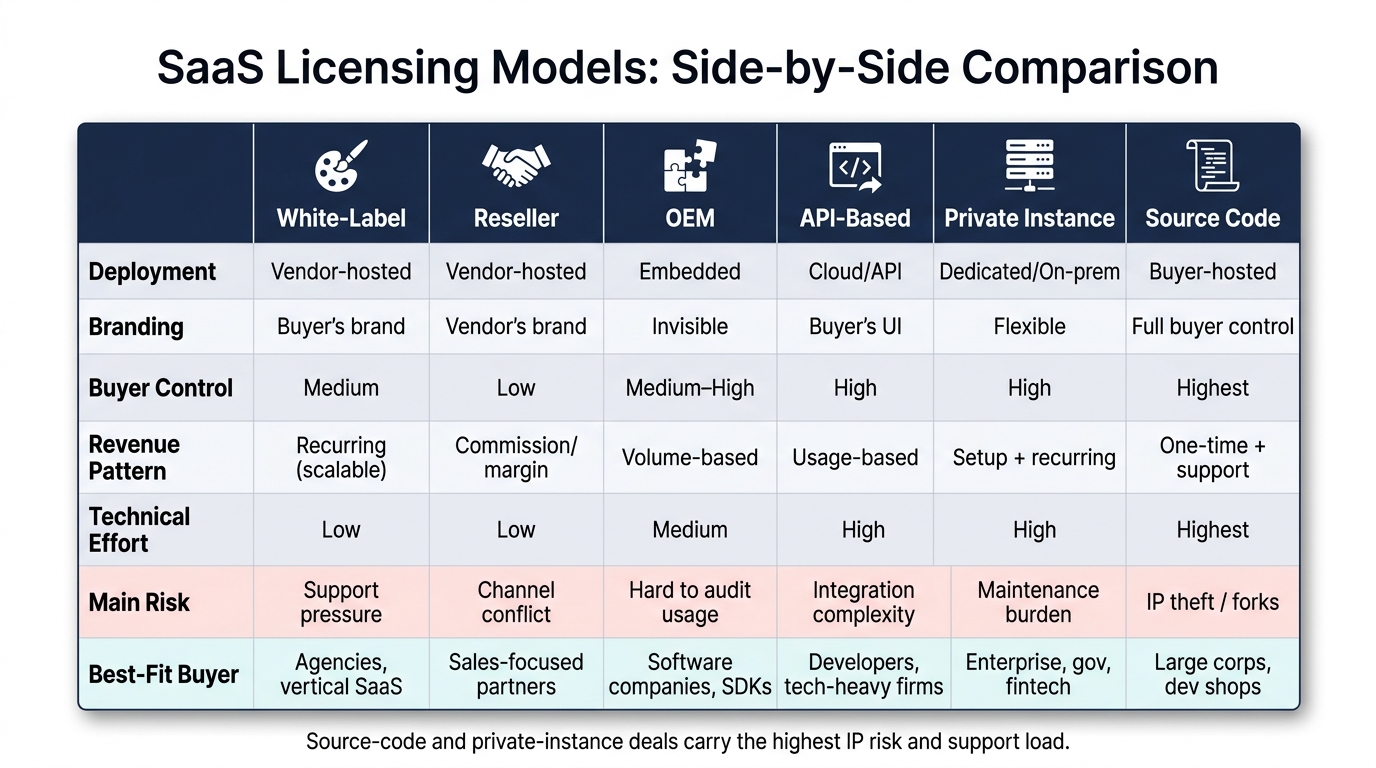
SaaS Licensing Models Compared: Which One Is Right for Your Deal?
B2B SaaS License Terms
sbb-itb-8650f75
Quick Comparison
| Model | Hosting | Branding | Buyer Control | Revenue Pattern | Main Risk |
|---|---|---|---|---|---|
| White-label | Vendor-hosted | Buyer brand | Medium | Recurring | More support pressure |
| Reseller | Vendor-hosted | Vendor brand | Low | Margin or commission | Channel conflict |
| OEM | Embedded | Usually hidden | Medium to high | Volume-based | Harder usage tracking |
| API | Vendor-hosted backend | Buyer UI | High | Usage-based | Integration work |
| Private instance | Dedicated environment | Flexible | High | Setup + recurring | More maintenance |
| Source code | Buyer-hosted | Full buyer control | Highest | Often one-time + support | IP leakage |
If I were doing this, I’d start by writing down the exact rights in plain English: who can use the product, how they can brand it, who hosts it, who supports it, what data rights apply, and how billing gets audited. That keeps the deal clear before legal review starts. Using a SaaS licensing agreement template can help ensure you don't miss critical clauses during this stage.
1. Get your SaaS ready for licensing
Before you start outreach, get the product ready for diligence. What you can license, how you deliver it, and which terms a buyer will sign all come back to the prep work you do now. If this part is clean, pricing and negotiation get a lot less messy later.
Define what you are actually licensing
Write down the exact rights included in the license. That means deployment type, branding rights, support scope, admin access, data rights, and who handles updates. Each choice affects pricing, support load, and contract terms.
Be just as clear about what is not included. If support has limits, say so. If branding rights are narrow, spell that out. The same goes for admin controls, data export, and responsibility for infrastructure and updates. It’s much easier to set boundaries now than fix confusion in the middle of a deal.
Confirm legal and technical readiness
On the legal side, confirm that you own the software and related IP, or that you have the rights needed to license it properly. Also check that no grant, contract, or third-party term limits the rights you plan to license [3]. If federal funds helped develop the software, preserve the government’s royalty-free, non-exclusive rights under 2 CFR § 200.315 before licensing [3].
On the technical side, buyers will want proof that the product can handle a licensing setup without a pile of custom work. They’re not just buying code. They’re buying a setup they can use, manage, and verify—similar to how you might launch a vertical SaaS using white-label software.
| Readiness Category | What to Confirm |
|---|---|
| Rights to License | You own the software or have rights that allow sublicensing and redistribution |
| Branding Flexibility | Custom domains, SSL, logo injection, color palettes, favicons, and branded email domains are supported |
| Admin Controls | Licensees can create, track, and revoke seats or API keys |
| Auditability | Usage telemetry and audit rights are documented so usage and revenue can be verified |
| Data Handling & Portability | You have a Data Processing Agreement (DPA) ready for GDPR/CCPA compliance, and clients can export data in CSV or JSON |
| Security Documentation | Provide uptime history, backup practices, and a security overview |
| Hosting & Updates | It's clear in writing who is responsible for infrastructure, patches, and version upgrades |
Finish this checklist before outreach so you can answer diligence questions fast and keep the deal moving. Once the product is ready, the next step is choosing the licensing model that fits the deal.
2. Choose the right B2B licensing model for the deal
Once legal and technical prep is done, the next step is picking the licensing model that fits the buyer.
This choice affects branding, hosting, control, compliance, pricing, support, and contract scope. It also shapes how much freedom the buyer gets and how much risk you take on. Different buyers want different things. Some want your product under their brand. Some want to sell it as-is. Others want deep control over hosting or even the code itself.
Pick the model before you draft terms. That way, pricing, support, and exclusivity line up with the actual deal.
White-label, reseller, and OEM deals
These three models often get lumped together. On paper, they can look similar. In practice, they work very differently.
White-label means your software runs on your infrastructure, but the buyer sells it under their own brand. This setup is common with agencies and vertical SaaS companies. They want to look like they built the product, while you handle the backend.
Reseller deals keep your branding in place. The partner sells your product and makes money through a commission or margin. This works best for partners that are strong at sales and distribution, but don't need deep product control.
OEM deals go a step further. Your software is built into another product or service, and your branding usually disappears. The buyer pays based on volume. This is a common fit for software companies and SDKs, where your product becomes one part of a larger offer.
API, private-instance, and source-code licensing
These models come with more technical work. They usually make sense for buyers with engineering teams or strict compliance demands.
API-based licensing gives the buyer programmatic access to your functionality. They build their own UI on top of your backend. This fits buyers that want to control the user experience [1][2].
Private-instance licensing gives the buyer a dedicated copy of your software in a separate environment. That could be a dedicated cloud setup or the buyer's own infrastructure. Enterprise buyers often ask for this because of strict security, GDPR, or banking-secrecy rules [3][4]. These deals often include a setup fee plus annual hosting or maintenance fees.
Source-code licensing gives the buyer the broadest set of rights. They host the software themselves, can modify it, and control branding end to end. It's often a one-time deal, so recurring revenue is lower for you. The tradeoff is clear: this model brings the highest IP risk, including theft, forks, and direct competition.
Use the comparison below to line up the model with the buyer's needs around control, hosting, and revenue.
| Model | Deployment | Branding | End-Customer Relationship | Technical Effort | Recurring Revenue | Principal Risks | Best-Fit Buyer |
|---|---|---|---|---|---|---|---|
| White-Label | Vendor-hosted | Buyer's brand | High (buyer) | Low | High, scalable | Vendor dependency; brand reputation | Agencies, vertical SaaS |
| Reseller | Vendor-hosted | Vendor's brand | Shared | Low | Medium, commission-based | Pricing erosion; channel competition | Sales-focused partners |
| OEM | Embedded | Invisible | High (buyer) | Medium | High, volume-based | Hard to audit usage; tied to partner success | Software companies, SDKs |
| API-Based | Cloud/API | Buyer's UI | High (buyer) | High | Medium, usage-based | Integration complexity; rate limits | Developers, tech-heavy firms |
| Private-Instance | Dedicated/on-prem | Flexible | Full | High | High, flat or tiered | Maintenance burden; update lag | Enterprise, gov, fintech |
| Source-Code | Buyer-hosted | Full control | Full | Highest | Low, usually one-time | IP theft; forks and direct competition | Large corps, dev shops |
3. Package your offer and set pricing that is easy to sell and audit
After you pick the licensing model, turn it into an offer the buyer can price, check, and renew without confusion. The terms need to hold up later, not just look good during the sale.
Group your offers into three deal types: Ownership (source code), Usage (monthly or per-user), and Partnership (revenue share, managed service provider, value-added reseller) [1]. Use these ownership, usage, and partnership structures to fit the deal model you chose in Section 2.
Most deals should include a setup fee for onboarding and deployment [2]. You should also add a recurring license fee tied to a metric you can track. For pilots, use 30–90-day evaluation or trial licenses that prohibit production use until the buyer converts [1][3]. Annual billing should cost less than monthly billing so longer commitments get rewarded [1].
Match your pricing metric to measurable customer value
Pick a metric you can measure and audit. The best pricing metric is the one that lines up with how the buyer gets value from your product.
| Billing Metric | Best Fit | Scaling Behavior | Buyer Concern | Audit Metric |
|---|---|---|---|---|
| Per-Seat / User | Enterprise SaaS | Linear with headcount | Seat recycling / sharing | Active user logs |
| Usage-Based | APIs, AI, automation | Scales with consumption | Unpredictable monthly bills | API calls, tokens, or records |
| Flat Monthly | Agencies, white-label | Fixed cost | Harder to justify at low volume | Contract term / instance count |
| Revenue Share | High-volume resellers | Aligned with growth | High cost at high scale | Gross revenue reports |
| Tiered Partner Pricing | Multi-tier distribution | Volume-based discounts | Moving between tiers | Total volume or seats |
| Source Code | Developers, full control | One-time high cost | Maintenance responsibility | Source-code handoff |
For most agency and white-label deals, flat-fee pricing tends to work best. It gives the buyer a fixed cost and gives you steady revenue. For API-based deals, usage-based pricing is usually the better fit because the buyer pays based on what they consume.
Set branding terms before the deal closes
Once pricing is set, lock down branding rights before the draft goes to legal.
Define the branding scope with precision. Spell out exactly what the buyer can change: logo, colors, favicon, custom domain with SSL, email templates, and mobile app store listings [2]. Everything else stays locked. Put those branding rights into the agreement before you finalize support, data, or exclusivity terms.
Those branding limits should sit in the written license alongside support, data, and exclusivity terms.
4. Put rights, responsibilities, and risk controls in writing
Once pricing and branding are settled, put the deal into a SaaS licensing agreement that sets the rules on rights, service levels, and risk. In practice, that usually means a master agreement, an order form, an SLA, and data terms. Keep security and support in separate schedules so each piece is easier to manage.
Define the license grant, restrictions, and customer relationship
The license grant is the core clause in the agreement. It needs to answer four things without wiggle room: who can use the product, where they can use it, what use is allowed, and whether sublicensing or assignment is permitted.
In white-label and reseller deals, spell out who signs with end customers and who owns support, billing, and renewals. The agreement should also state which trademarks, product names, and brand assets the partner may use.
Then define how much market access the partner gets. If exclusivity is part of the deal, label it clearly as exclusive, sole, or non-exclusive, and set the exact scope in the contract [3].
Document service levels, data terms, and legal protections
The SLA should set uptime targets, support response times, and escalation paths. Those promises need to match the licensing model in play - white-label, reseller, API, or private-instance - so the service terms line up with how the product is delivered.
Data terms should also be plain about controller and processor roles. In most partner-led deals, the licensor processes data for the licensee, the licensee acts as controller, and the end customer is the data subject. Those roles should track the operating split already set in the deal.
Here’s how responsibility often breaks down across the full deal lifecycle:
| Responsibility | Licensor (Vendor) | Licensee (Partner) |
|---|---|---|
| Software Development & Roadmap | Primary | Feedback/Requests only |
| Sales & Marketing | - | Primary |
| Implementation/Onboarding | Support Role | Primary |
| Infrastructure & Hosting | Primary | None |
| Branding & UI Theming | Provides Tools | Executes Customization |
| First-Line Support (L1) | None | Primary |
| Technical/Bug Support (L2) | Primary | None |
| Security Patches & Core Updates | Primary | None |
| Data Privacy (Processor) | Primary | None |
| Data Privacy (Controller) | None | Primary |
| End-Customer Billing | None | Primary |
| Downstream Compliance | None | Primary |
| Renewals | None | Primary |
After rights and data terms are nailed down, add the clauses that protect both sides if things go off track. That usually includes confidentiality, indemnification, a liability cap, suspension rights, termination rights, and transition support.
5. Close the deal and manage it after signing
Once the agreement is signed, the job shifts from closing to handoff. That shift matters more than it sounds. A fixed workflow helps stop scope drift, slow provisioning, and payment fights before they start. The signed license, SLA, and data terms should serve as the handoff checklist.
Run a deal workflow from proposal to provisioning
The signed license should spell out what happens next: validation, payment, provisioning, and audit. Start with buyer qualification. Make sure there’s a real buying need, a clear use case, and the technical ability to run the model.
After the model is chosen and the terms are scoped, review the setup before drafting anything. That means checking multi-tenant isolation, API completeness, and any compliance duties tied to the deal. For AI-enabled deals, document those compliance duties before the pilot begins. Then align the pilot scope with the model the buyer chose, whether that’s white-label, API, private-instance, or source-code. Run a 30–90 day nonproduction pilot with written acceptance criteria.
Before granting production access, collect payment. Use escrow until delivery is accepted. After that, provision tenant accounts, API keys, domains, or source-code materials based on the deal. Before go-live, confirm that the deployed code and infrastructure match the signed scope.
Once the environment is live, move from delivery into monitoring. Post-signing management helps protect license revenue. Use feature flags to enforce tiers, and use audit rights to support usage-based billing.
| Workflow Stage | Key Actions |
|---|---|
| Qualification | Verify buying need; match buyer to model |
| Scoping | Set pricing metric, structure, and terms |
| Validation | Check multi-tenancy, API readiness, compliance |
| Negotiation | Finalize IP, sublicensing, audit, SLA |
| Payment | Collect fees; confirm delivery |
| Provisioning | Create tenants, keys, domains, or code access |
| Management | Monitor usage, renewals, and overages |
Use LicenseSaaS to manage the transaction
Use LicenseSaaS to move the deal from proposal to provisioning without losing track of documents, payment, or compliance. It handles listings, buyer requests, document sharing, escrow, provisioning, and post-signing compliance in one workflow.
AI-generated agreements can help speed up drafting, but counsel should review the final terms. After signing, use license management to track renewals, usage, and audits.
FAQs
How do I choose the right SaaS licensing model?
Choose the license model that matches your revenue target, buyer, and where your product stands today.
- Ownership licenses make sense for mature products or cases where buyers need deep customization.
- Usage licenses work well if you want steady, scalable revenue.
- Partnership licenses are a good fit when growth depends on resellers.
It also helps to look at your multi-tenant setup, your support bandwidth, and whether you want to keep your own brand front and center or let partners white-label the product.
What should a SaaS licensing agreement include?
A SaaS licensing agreement should spell out the terms that protect your intellectual property, set clear usage limits, and keep day-to-day operations from turning into a mess.
Some of the key clauses to cover are sublicensing rights, territory limits, branding removal for white-label deals, audit rights, IP ownership for derivatives or custom work, post-termination data return, SLA pass-through duties, and change-of-control terms.
How should I price a B2B SaaS licensing deal?
Price your deal around the business value your product creates for the licensee, not around what each end user might pay for a subscription.
Common setups include flat monthly fees ($200 to $20,000), revenue share (15% to 40% of gross revenue), usage-based pricing, and one-time source code purchases. If you go with usage-based pricing, add a monthly minimum so the deal doesn’t drift too low. It also helps to spell out price-lock terms, audit rights, and clear support limits so your margins don’t get squeezed as the licensee grows.