
10 Ways to Monetize Software You Already Own
You don’t need a new product to earn more from your software. I’d start by checking your code ownership, costs, and support capacity - then test one paid offer. For example, 100 customers paying $199/month would bring in $19,900 in monthly revenue, before expenses.
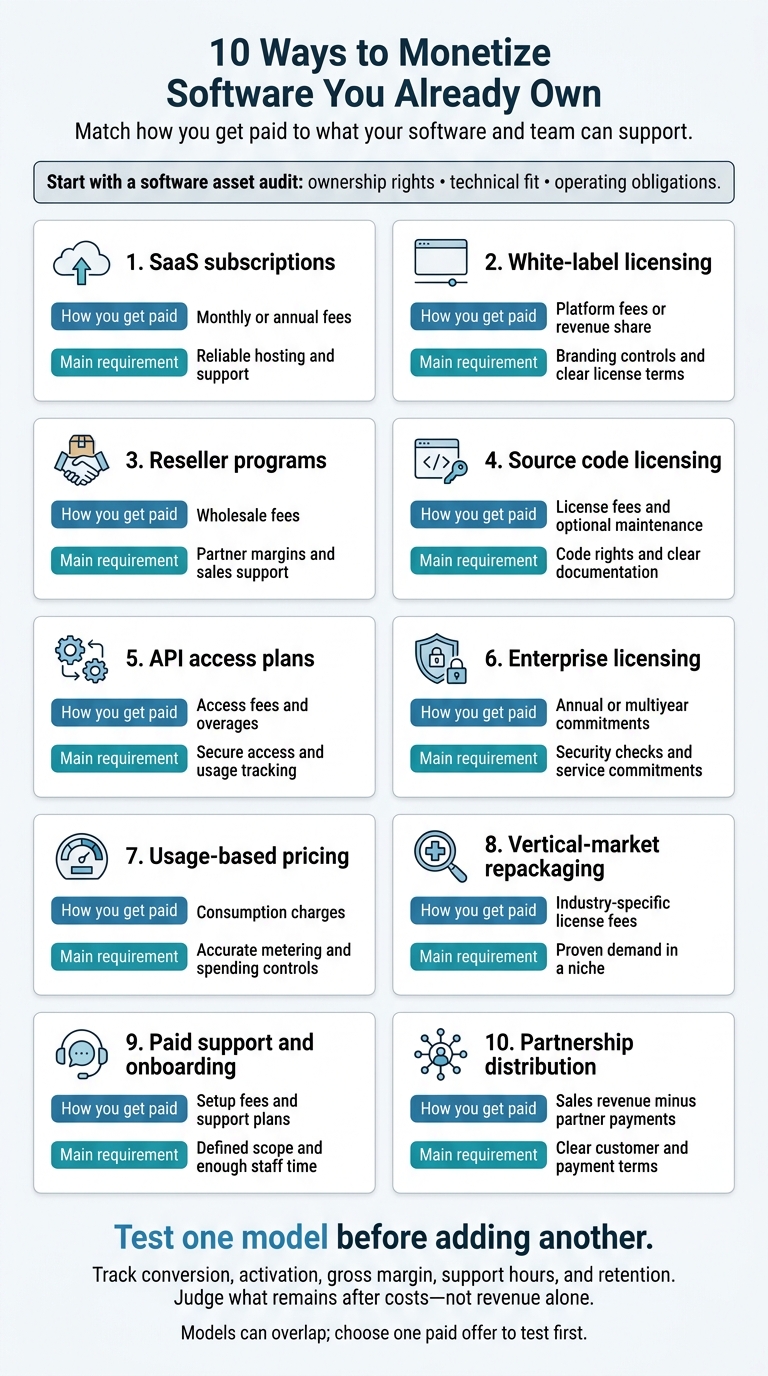
Here are the 10 options I’d compare:
- SaaS subscriptions: Charge monthly or yearly for hosted software.
- White-label licensing: Let buyers sell it under their own brand.
- Reseller programs: Give partners a discount so they can earn a resale margin.
- Source code licensing: Charge for rights to use or modify your code while keeping IP ownership.
- API access plans: Sell access to functions other products can use.
- Enterprise licensing: Negotiate larger deals with defined access, security, and support terms.
- Usage-based pricing: Bill for calls, transactions, storage, or other measured use.
- Vertical-market repackaging: Package your product for one industry.
- Paid support and onboarding: Charge for setup, training, and help.
- Partnership distribution: Sell through another company’s audience or sales channel.
Quick Comparison
| Model | How you get paid | Main requirement |
|---|---|---|
| SaaS | Monthly or annual fees | Reliable hosting and support |
| White-label | Platform fees or revenue share | Branding controls and clear license terms |
| Reseller | Wholesale fees | Partner margins and sales support |
| Source code | License fees and optional maintenance | Code rights and clear documentation |
| API access | Access fees and overages | Secure access and usage tracking |
| Enterprise | Annual or multiyear commitments | Security checks and service commitments |
| Usage-based | Consumption charges | Accurate metering and spending controls |
| Vertical-market | Industry-specific license fees | Proven demand in a niche |
| Support and onboarding | Setup fees and support plans | Defined scope and enough staff time |
| Partnership distribution | Sales revenue minus partner payments | Clear customer and payment terms |
My rule: <u>test one model before adding another</u>. Put pricing, permitted use, support, renewals, and exit terms in writing. Platforms such as LicenseSaaS can help with buyer search and deal handling, but I’d judge each offer by what’s left after costs - not revenue alone.
10 Ways to Monetize Software You Already Own
Revenue Durability and Monetization Strategies in SaaS
sbb-itb-8650f75
Start With a Software Asset Audit
Before you pick a model, audit three things: ownership rights, technical fit, and operating obligations.
Start with IP ownership. Make sure you own the codebase, including any work created by contractors. Then flag open-source dependencies. MIT and Apache 2.0 are often fine for commercial use, while GPL can bring copyleft duties. This audit helps you match each asset to the right monetization path below.
Then review your technical architecture. If your software runs on multi-tenant cloud infrastructure with proper data isolation between customers, it’s a good fit for SaaS subscriptions or white-label licensing. If it includes an API with rate limits and usage tracking, API access plans make sense. And if the codebase is modular, transferable, and free of restrictive open-source components, source code licensing is on the table.
The rest of the audit comes down to branding scope, support load, and data handling. List every part that can be rebranded: logos, colors, custom domains, email templates, and "Powered by" attributions. Check your current support SLAs and onboarding docs too, because they set the baseline for any paid support or service-led model. If you handle customer data, map data residency requirements and portability options. That matters a lot in enterprise deals.
Match each audit result to the closest revenue model:
| Audit Factor | Best Monetization Path |
|---|---|
| Clean, portable codebase; no restrictive open-source | Source Code Licensing |
| API with rate limits and usage tracking | API Access Plans |
| Deep branding customization (logo, colors, custom domain, email templates) | White-Label Licensing |
| Multi-tenant cloud infrastructure | SaaS Subscriptions |
| High support or onboarding requirement | Paid Support / Onboarding |
| Strong regional or vertical demand, no local presence | Reseller Programs / Partnership Distribution |
Add any source code escrow requirement to your ownership notes.
Where LicenseSaaS Fits in the Monetization Process
Once you’ve picked a monetization model, the next job is execution: finding buyers, setting terms, and getting the deal done. That part matters because each model calls for a different kind of buyer, a different contract setup, and a different handoff process.
LicenseSaaS is a deal platform built for licensing, white-labeling, reselling, and distributing software while you keep IP ownership. In plain English, it gives you one place to list offers, negotiate terms, and close deals across:
- white-label vs SaaS licensing
- source code licensing
- API access plans
- reseller programs
- SaaS deals
It also matches buyer requests, supports secure due diligence, generates agreements, handles escrow, and tracks renewals after the deal closes. Listing and browsing are free. Fees apply only when a deal closes.
The table below shows how each deal stage lines up with the workflow LicenseSaaS supports.
| Deal Stage | LicenseSaaS Feature |
|---|---|
| Discovery | AI Deal Matching & Buyer Request Board |
| Due Diligence | Secure Deal Room & Data Room |
| Legal | Agreement Generation |
| Financial | Escrow-Protected Payments |
| Technical Handover | Guided Deployment & Code Verification |
| Ongoing Management | Renewal and Usage Tracking |
1. SaaS Subscriptions
A SaaS subscription turns software you already own into a hosted service that people pay for monthly or yearly. If your software already supports multi-tenancy and works well with subscriptions, this is the most direct way to make money from it.
From the audit, SaaS works best when hosting and support are already under control. It makes sense when the product solves a repeat problem and doesn’t need much customer-by-customer setup. It tends to fall short when buyers want offline access, control over the source code, or custom deployments. In those cases, different SaaS license models are usually a better fit.
Keep pricing simple with two or three tiers. For example:
- A self-serve plan at about $49/month
- A professional plan at about $199/month
- An enterprise tier with custom terms
A 2025 benchmark found a $29 median entry plan price per user per month, and 61% of companies use hybrid pricing: a base fee plus seats, usage, or add-ons.[6] Annual billing usually comes with a 15%–20% discount compared with monthly billing, and it helps make cash flow easier to predict.[5]
The tradeoff is pretty clear: recurring revenue also means recurring work. You’re on the hook for hosting, uptime, security, backups, and support all the time. Before you launch a subscription offer, spell out your support hours, response targets, and your rules for data export and deletion after cancellation.
Retention is what makes or breaks this model. Gross revenue retention averages 88% in subscription and hybrid pricing models.[4] That means losing 12% of revenue each year on average, so you need a steady stream of new customers just to stay even. At 100 customers paying $199/month, your MRR is $19,900. Then you need to subtract hosting, support, and payment processing costs to see what you’re actually keeping. If buyers want to sell the software under their own brand, the next option is white-label licensing.
2. White-Label Licensing
White-label licensing means another company can rebrand your software as its own and sell it under its own name. They set their own prices, manage their own customers, and build their brand on top of your code. You still own the IP and collect fees from each licensee.
This setup can work well when you've started to hit a ceiling in your current niche. For example, a niche founder could take your general-purpose CRM, rebrand it for dental practices or other agency niches, and bring it to market in weeks. That kind of move can open a new revenue lane without asking you to build new features. In some cases, white-labeling can add 40%+ to a founder's revenue.[2]
Before putting this on the table, check how far your software can go with rebranding. Buyers usually expect:
- Custom domains
- Their own logo
- Custom email templates
- No visible branding or metadata[2]
Support usually gets split in a pretty clear way. The licensee owns the customer relationship and handles first-line support. You take care of uptime, infrastructure, and escalated bugs. Simple in theory. The hard part is the contract.
You'll want to spell out things like sublicensing rights, data portability windows, ownership of custom modifications, audit rights, and change-of-control terms.[3]
Pricing usually falls into one of these buckets:
- A flat monthly fee
- A revenue-share model
- A tiered fee based on the number of end customers
LicenseSaaS can help source white-label deals, generate agreements, and manage negotiation in a secure deal room.
3. Reseller Programs
If white-label licensing is about rebranding, reseller programs are about distribution.
A reseller program lets another company sell your software at a discount and keep the margin. The reseller may take care of quoting, onboarding, and first-line support. You still own the software and IP. The partner makes money from its sales channel.
This setup works best when your software solves a clear problem and the partner already sells to the same buyers. Think IT consultants, marketing agencies, managed service providers, or system integrators that are stable, repeatable, and easy to demo without major product changes. For example, a construction-tech consultancy could sell your workflow software at 25% off list price, handle first-line support, and leave uptime and technical escalations to you.[10][11][12]
Margins matter here. Industry guidance puts reseller discounts in the 15% to 30% range. Value-added resellers and managed service providers often land closer to 20% to 40% because they bundle implementation, training, or managed services.[13][14]
Here’s what that looks like in plain English: if your public price is $1,000 per month and a reseller gets a 25% discount, they pay $750 and can keep up to $250 before their own costs.
In most cases, the split of work is pretty simple:
- The reseller handles demos, quoting, onboarding, training, billing, and first-line support.
- You handle bug fixes, uptime, security, documentation, and escalations.
That arrangement works when the partner is selling your product, not changing it into something else.
The contract is where resale starts to look different from referral. Keep the agreement centered on the reseller terms that matter most: territory, exclusivity, discount bands, customer ownership, and renewal rights.[8][9] Deal registration can also protect the opportunity for the partner who brings it in first, sometimes with an extra 5% to 10% discount.[7]
If a partner wants more control than resale allows, source code licensing is the next step.
4. Source Code Licensing
Source code licensing gives a buyer stated rights to access, use, modify, maintain, and sometimes redistribute your code while you still keep IP ownership. Use this model when the code has standalone value on its own.
In plain English: you're not selling the company or giving away ownership of the software. You're licensing the code under terms you control.
That can turn transferable code into a high-control revenue stream. It tends to work best for founders with a mature, well-documented product, agencies with reusable internal tools, or software companies that serve regulated or security-sensitive customers. These buyers often need on-premises deployment, custom integrations, or the ability to run and maintain the system themselves.
This model fits when buyers need control, not just access. The license can be exclusive or nonexclusive.
Pricing should match the rights you're granting. Broader rights like exclusivity, sublicensing, or future releases should come with a higher fee. A practical setup can include:
- an upfront fee
- a running royalty
- a minimum annual royalty
- an annual maintenance fee [19]
One point matters a lot here: code handoff does not mean support is included. The agreement should spell out bug fixes, security patches, documentation updates, response times, and any paid training or custom engineering.[17][21]
The contract also needs to cover modifications, derivative works, sublicensing, termination, open-source compliance, and export controls.[20] If you skip those details, things can get messy fast.
Source code escrow is another option if the buyer wants continuity protection without immediate handover. In that setup, the code sits with a third party and can be released under stated conditions. Escrow agreements typically cost about $1,000 to $2,000 per year, though actual fees vary by provider and verification requirements.[15][16][18]
If buyers want usage access without code control, API access plans are the lighter-weight option.
5. API Access Plans
API access plans let you keep the code and infrastructure while charging for programmatic access to specific functions. If the buyer doesn't need code ownership, this is the lighter option.
This setup works well for software that handles a repeatable, measurable task - like document processing, validation, analysis, scheduling, or workflow automation - that other companies want to plug into their own products. It's a good fit if you already have reusable functions built into the product.
Pricing usually falls into three buckets:
- Pay-as-you-go: charge per request or transaction
- Subscription with included usage: a monthly fee that covers a set number of calls
- Hybrid: a base subscription plus overage billing when usage goes past the included allowance
Hybrid pricing tends to work well for B2B APIs because it gives customers a predictable budget while helping you protect margins when usage jumps. A simple three-tier setup might look like $49/month for 50,000 calls, $199/month for 500,000 calls, and custom enterprise pricing above that.[23]
But pricing is only part of the story. What makes an API usable at scale is reliability and version control.
If you offer API access, you're on the hook for platform reliability: uptime, authentication, usage monitoring, versioning, and developer documentation. The contract should spell out uptime, authentication, rate limits, and escalation paths.
For self-serve plans, include acceptable-use terms, quotas, overage fees, and data-handling rules. Enterprise deals usually add SLAs, security reviews, data-processing agreements, and negotiated pricing. At every tier, publish your versioning and deprecation policy upfront so customers know how much notice they'll get before a breaking change. If buyers need broader access rights, tighter SLAs, or custom compliance terms, move them to enterprise licensing models.
6. Enterprise Licensing
When buyers need broad access and formal purchasing terms, enterprise licensing is usually the next move. It’s a negotiated agreement that gives one company broad software rights across teams, offices, or regions. The deal spells out scope, deployment, support, security, pricing, and termination. The key point: you’re making more money from the same product by selling broader rights, not by shipping new features.[25][26]
This model fits best when the product is already part of business-critical work. The strongest fit is often founders with proven B2B tools and agencies that have turned an internal platform into a product they can sell again and again. Enterprise buyers are paying for scope, control, and predictability. So if your product is still changing fast, or you can’t yet back it up with steady support and security commitments, this route can get messy fast.
Pricing is almost never public. It’s usually worked out in the sales process. Common setups include:
- One- to three-year subscriptions
- Per-seat or concurrent-user pricing
- Site licenses
- Enterprise-wide fees
- Hybrid base-plus-overage pricing
For a three-year commitment, a 15%–25% discount is a common benchmark, and annual renewal increases are often capped at CPI or 3%–5%.[28] Multiyear agreements usually last three to five years.[24][25]
The contract also gets much more detailed than a small-business plan. It covers support tiers, SLA targets, maintenance scope, data handling, IP ownership, audit rights, and termination terms. In plain English, it puts into writing what smaller plans often leave unsaid. A common support baseline is one hour for critical incidents, four hours for high-priority issues, and 24 hours for standard incidents.[28]
Enterprise buyers now expect proof on security, too. That often means penetration-test summaries, data-portability commitments, and breach-notification timelines.[27] Before signing, have a software transactions attorney review the agreement. The upside is larger, steadier revenue. The tradeoff is a longer sales cycle and heavier service demands.
7. Usage-Based Pricing
Usage-based pricing means customers pay for what they use. Not a flat fee. Not a per-seat charge. Usage is what drives the bill. This setup works well for metered products like APIs, automation tools, and data-heavy workflows.
It tends to make the most sense when the value a customer gets and your cost to serve move in the same direction. If usage goes up, both sides can see why the bill goes up too.
The metered unit is a big deal here. Common pricing models and contract terms include:
- API calls
- AI tokens
- Workflow runs
- Storage
- Transactions
For this model to work, you need API-key access controls and a clear contract that spells out what counts as a metered unit. A monthly minimum commitment - usually 50% to 70% of expected usage - helps protect baseline revenue. Audit rights also matter because they let you verify usage if a dispute comes up. The buyer handles first-line support. You handle uptime, infrastructure, and escalated bugs. [3]
One big plus is the lower entry point. That often helps these deals close faster than flat-rate or seat-based pricing. The downside is less predictable revenue. That’s why metering and minimum commitments matter so much. This model can monetize software you already have without changing the product, but revenue will rise and fall with usage. If your software fits a specific industry use case better than a metered setup, vertical-market repackaging is the next move.
8. Vertical-Market Repackaging
If one industry wants your product more than the market at large, package it for that niche. That’s what vertical-market repackaging is: taking a general-purpose software product and offering it in a form built for one industry.
Here’s the simple version. Instead of selling a generic CRM to anyone who’ll buy it, you license a dental-specific version to a buyer that serves dental practices. The core product stays the same. But the market position changes, and so does the price. Vertical offers often earn 2x to 3x generic pricing because they fit one industry’s workflows so well.[2]
This works best when you already have a stable, self-contained product - like a booking tool, analytics dashboard, reporting suite, or CRM - and you’ve hit a growth ceiling in your current market. At that point, you don’t need to rebuild the product from scratch for a new industry. You can license an industry-specific version to a licensee that already has distribution in that space.
The split of responsibilities is pretty clean. The licensee handles first-line support. You stay on the hook for the platform itself, including uptime and escalated bugs.[3]
The contract matters a lot here. It should include a clear Field of Use restriction so the licensee can’t start selling into nearby industries that you still serve directly. If they want vertical exclusivity, expect higher fees. In most cases, that also comes with a minimum revenue commitment to keep those rights.[3]
From an ops standpoint, this model is light. Feature flags let you turn industry-specific functionality on or off for each licensee, so you don’t end up running separate codebases. Keep one codebase.
| Feature | Horizontal SaaS (Original) | Vertical-Market Repackaging |
|---|---|---|
| Target Audience | General business users | Industry-specific (e.g., dentists, law firms) |
| Pricing Power | Standard market rates | 2–3x premium [2] |
| Support | Owner handles all levels | Licensee handles 1st line; owner handles platform [3] |
| Customization | Generic features | Industry-specific workflows and fields |
If the buyer needs implementation help more than a niche version of the product, the next model is paid support and onboarding.
9. Paid Support and Onboarding
Paid support can become its own revenue line when customers need help installing, configuring, or running your software. Put simply, it lets you earn more from software you already sell. This tends to work best when the product already has demand, but buyers still need hands-on help to get to launch or keep things running.
This setup is a strong fit for on-premises licensing, white-label deals, and enterprise implementations. In those cases, buyers often pay for setup work and ongoing expert help. One of the most common starting points is concierge onboarding: installation, branding, and launch checks. That’s usually priced as a one-time setup fee, often in the $500–$5,000 range, depending on complexity. [2]
The revenue model changes based on who owns the customer relationship and who does the day-to-day support work.
| Support Type | Who Handles It | How It's Priced |
|---|---|---|
| First-Line Support | Licensee (buyer) | Included in the licensee's retail price to end-users |
| Second-Line Support | Software owner (seller) | Included in the monthly or annual license fee |
| Brand-Neutral Support | Software owner (seller) | Paid add-on or higher-tier royalty [3] |
| Concierge Onboarding | Software owner (seller) | One-time setup fee [2] |
| Maintenance | Software owner (seller) | Annual maintenance fee [1] |
There’s a simple reason this model works: it adds revenue without changing the core product. If you already make money from licenses or subscriptions, support can stack on top of that.
The pricing approach also shifts with the delivery model:
- SaaS usually leans on SLA-based support
- Delivered software usually leans on patches, fixes, and maintenance
Once support has its own price, the next move is setting the SaaS licensing agreement clauses that spell out fees, renewals, and scope.
10. Partnership Distribution
Partnership distribution means selling through another company’s audience, sales team, or service channel. The software stays the same. What changes is the path to the customer.
This model works best when the software is already proven, onboarding is repeatable, and direct reach is limited. Good partners often include IT consultancies, MSPs, agencies, accountants, and niche specialists that already work with your buyers. It’s a poor fit if uptime is shaky or the partner’s cut is too small to keep them interested. After that, the big call is simple: how do you pay the partner, and who owns the customer relationship?
A referral partner makes less than a reseller or OEM partner. Typical market ranges show that referral partners earn 10%–20% of first-year revenue, while resellers usually get a 20%–40% margin or an ongoing revenue share.[29][30] For example, on a $24,000 annual subscription, a 20% referral commission comes to $4,800. That turns the same software into a new sales channel without changing the product itself.
In most setups, partners take care of prospecting, demos, onboarding, and first-line support. You stay responsible for maintenance, security, and escalations.
Things get more complex as the partner gets more control. Referral agreements are usually straightforward. Reseller and OEM deals need more detail around:
- pricing authority
- customer ownership
- IP limits
- renewal commissions
- deal registration
- exit terms
Broad exclusivity is usually a bad bet at launch. If you do need it, tie it to clear commitments like minimum annual revenue, certified staff, or a set number of implementations. Otherwise, you can give up market access without getting steady distribution in return.[8][14][31] And that’s where pricing and renewal structure start to matter a lot.
| Partnership Type | Typical Compensation | Partner's Main Responsibilities |
|---|---|---|
| Referral | 10%–20% of first-year revenue | Introductions and qualification |
| Reseller | 20%–40% margin or revenue share | Sales, billing, and first-line support |
| OEM / Embedded | Per-unit royalty or 10%–30% revenue share | Integration, bundled distribution, and support |
Key Deal Terms and Pricing Structures to Know
Once you pick a monetization model, the next step is simple in theory and messy in practice: the contract terms decide how the deal plays out day to day. No matter which licensing model you choose, most deals come back to the same core items - billing, fees, usage, revenue share, territory, commitments, and termination.
Billing cadence is usually the first call to make. Monthly billing tends to fit buyers who want less commitment upfront. Annual billing often makes more sense when onboarding takes work or when the product becomes part of daily operations. Put the basics in writing: billing date, payment method, renewal date, taxes, refunds, and how much notice you’ll give before a price change.
It also helps to separate implementation fees from recurring platform fees. A one-time implementation fee should cover named deliverables, such as configuration, data migration, integrations, training, and launch support. The recurring platform fee should cover the hosted service, routine updates, and baseline support. Support and maintenance should also stand apart from the underlying license, since they can come with their own terms, renewal dates, and service levels.
With usage-based pricing, details matter a lot. Define the metering method, billing interval, rounding rules, rollover or expiration policy, notification thresholds, and overage rate in writing. If customers want more predictable costs, prepaid credits can sit alongside overages and make the bill less of a surprise.
Revenue share, commissions, and royalties make the most sense when a distributor, reseller, or licensee plays a real role in generating sales, managing customer ties, or handling delivery. In those cases, spell out whether payments are based on gross or net revenue, which deductions are allowed, when payments are due, and whether audit rights apply.
Exclusivity should never float on its own. Tie it to performance thresholds, and define territory, sublicensing, resale rights, and ownership of derivative works.
Minimum commitments come into play when you need to reserve capacity, provide dedicated support, or make custom development worth the effort. Be clear about the commitment amount, the time period, any rollover rules, and what happens if the customer falls short.
Termination terms need equal care. Cover the triggers for termination, notice and cure periods, when access gets cut off, whether refunds apply, how data export or deletion works, what transition support looks like, and which clauses survive after the contract ends.[32][22][33]
| Term Category | What to Define |
|---|---|
| Billing Cadence | Payment method, renewal date, taxes, refunds, price-change notice |
| Implementation Fees | Deliverables, milestones, acceptance criteria, out-of-scope rates |
| Usage & Overage | Metering method, allowance, billing interval, overage rate, alerts |
| Revenue Share / Commissions | Gross vs. net basis, deductions, payment timing, audit rights |
| Minimum Commitments | Amount, period, rollover rules, shortfall remedies |
| Territory & Exclusivity | Performance thresholds, sublicensing rights, resale rights, derivative-work ownership |
| Renewal Terms | Auto-renewal, notice period, renewal pricing, cancellation deadline |
| Support Scope | Channels, hours, severity levels, response targets, exclusions |
| Termination | Triggers, cure periods, access cutoff, refunds, data handling, surviving clauses |
Use these terms to compare the models below.
Model Comparison Tables
Once you’ve reviewed deal terms, compare who owns the customer, who does the work, and how revenue scales. The table below shows who sells, who supports customers, and who carries the day-to-day business risk.
| Dimension | Referral | Reseller | White-Label |
|---|---|---|---|
| Who owns the customer | Owner | Partner | Partner |
| Brand shown to customers | Software owner’s | Owner-branded or co-branded | Partner’s |
| Pricing and billing | Owner sets the price | Partner sets the resale price and invoices | Partner sets customer pricing and bills the customer |
| Partner take | Commission or referral fee | Difference between wholesale and resale price | Revenue after platform, support, and delivery costs |
| Owner take | Customer payments minus commission | Wholesale access fees | Platform fee, per-customer fee, minimum commitment, or revenue share |
| First-line support | Owner | Partner | Partner |
| Owner workload | Sales, billing, support, and delivery | Partner enablement and escalations | Branding setup, platform maintenance, and escalations |
Enterprise deals change procurement and contract obligations more than the product itself. Enterprise licensing changes the buying process and contract - not always the hosting model.
| Dimension | Standard SaaS Subscriptions | Enterprise Licensing |
|---|---|---|
| Pricing structure | Published monthly or annual tiers; per-user or usage pricing | Negotiated annual commitments; seat, volume, site, or unlimited-use pricing |
| Sales process | Self-service or repeatable sales process | Procurement and stakeholder approval |
| Security review | Standard documentation | Buyer-specific review and requirements |
| Implementation | Repeatable onboarding | May require migration, integrations, and training |
| Customization | Standard features and settings | Negotiated integrations or deployment options |
| Contract length | Monthly or annual | Annual or multiyear |
| Contract value | Set by published plan and consumption | Set by scope, volume, and commitments |
| Renewal exposure | Revenue spread across many accounts | Losing one large account can have a greater impact |
Some models earn revenue from the deal; others earn it from the work around it. Keep launch work, support, and managed services separate. Each scales differently.
| Dimension | Implementation Fees | Support Plans | Managed Services |
|---|---|---|---|
| Primary purpose | Get the customer launched | Help the customer use the software | Run part of the customer’s workflow |
| Deliverables | Configuration, migration, integrations, training | Troubleshooting, guidance, priority assistance | Monitoring, administration, optimization, recurring reports |
| Billing pattern | One-time, milestone-based, or time-and-materials | Recurring tiered fee | Recurring fee tied to workload and scope |
| Staffing demand | Concentrated around launch | Varies with ticket volume and coverage | Staff capacity needed to keep the service running |
| Scalability | Limited by onboarding hours | Improves with standardized service tiers | Limited by labor required per account |
| Margin pressure | Underestimated setup work | Heavy ticket volume | Recurring work exceeding the agreed scope |
The estimates below are for planning. Setup covers billing, documentation, legal work, and partner enablement. Here, scalability means adding customers without adding a similar amount of labor.
| Model | Setup Effort | Revenue Pattern | Scale | Continuing owner work | Legal complexity | Best fit |
|---|---|---|---|---|---|---|
| 1. SaaS | Low–medium | Monthly or annual recurring | High if standardized | Low–medium | Low–medium | Stable, multi-tenant cloud apps |
| 2. White-label licensing | Medium–high | Setup fees + recurring access | High with repeatable branding | Medium | High | Rebrandable tools with separate accounts |
| 3. Reseller programs | Medium | Wholesale access payments | High with repeatable onboarding | Low–medium | Medium | Proven, partner-ready products |
| 4. Source code licensing | High | License fee + optional maintenance | High with standardized, nonexclusive licenses | Low–medium after delivery | High | Mature, documented, transferable code |
| 5. API access plans | Medium–high | Access fees + allowances or overages | High | Medium | Medium | Reliable, secure API functionality |
| 6. Enterprise licensing | High | Annual or multiyear commitments | Medium | High | High | Security- and governance-ready software |
| 7. Usage-based pricing | Medium–high | Consumption charges + optional base fee | High with reliable metering | Medium | Medium | Metered APIs, AI, storage, or workflows |
| 8. Vertical-market repackaging | Medium | Recurring access + optional setup | Medium | Medium | Medium | Industry workflows that can be modified |
| 9. Support and onboarding | Low–medium | One-time onboarding + recurring support | Low–medium | High | Medium | Products needing hands-on assistance |
| 10. Partner distribution | Medium | Revenue share or partner-generated sales | Medium–high | Low–medium | Medium–high | Software complementary to partner offerings |
How to Choose the Right Monetization Path
Choose a model that fits your asset, buyer, and workload. Start with the comparison tables above, then use the audit to check hosting, deployment effort vs. licensing costs, brand flexibility, API exposure, measurable usage, IP rights, security controls, integrations, support capacity, and costs.
SaaS fits hosted products that keep delivering value. Choose source code licensing when buyers need to deploy, modify, or maintain the code themselves - and you own the licensing rights.
Your distribution model should match how partners reach buyers. White-label licensing suits partners that want to use their own brand. Reseller programs suit partners that sell through existing channels. Choose partnership distribution when a complementary audience, integration, or bundle can bring in demand without resale.
For programmable products, offer API access plans. Use usage-based pricing only when you can measure consumption and the value metric is clear, predictable, and scalable.[34] Common metrics include calls, transactions, records, and storage. Give customers usage visibility and spending controls before charging overages.
Choose enterprise licensing when your security, procurement, and support can handle large accounts. Before building a separate edition for vertical-market repackaging, test demand through interviews and a paid pilot. Offer paid support and onboarding as a defined service when migration, configuration, or training keeps buyers from adopting the product.
Launch one model first. Define one target buyer, one offer, one value metric, and one pricing structure. Package the offer, set the price, and test it with existing customers or similar prospects. Track conversion, activation, gross margin, support hours, and retention. Add a second model only after the first proves demand and its margin covers the added work.
Conclusion
Software you already own can earn more through better packaging, pricing, licensing, or distribution. Choose a model that fits how your software works, what buyers will pay for, and the support you can provide. Start with the option that takes the least effort to put in place.
Put the agreement in writing. Spell out permitted use, IP ownership, support, data rights, renewal, and termination. For partner deals, also define who owns the customer relationship, who can approve discounts, and how revenue shares are calculated.
Review results after the first billing cycle and at renewal before expanding into related models. Add a channel only when demand and unit economics support it, and keep obligations smaller than the revenue they create.
FAQs
How do I validate demand before choosing a monetization model?
Find agencies, resellers, or vertical SaaS companies that serve your market but don’t offer your features. Reach out to 50 to 100 qualified prospects to test their interest in licensing or white-labeling your software [1].
List your software on a specialized licensing marketplace to connect with buyers looking to license software and compare deal structures and product types [1][2]. Document your revenue history, active customer counts, and usage metrics to show traction and help confirm demand [3][2].
How do I price licensing deals profitably?
Base your price on the buyer’s commercial value - not your retail price. Model expected revenue to set a fee that works for your business over time.
You can charge a flat monthly fee for predictable costs, use revenue sharing - typically 10–40%, with audit rights - or set per-call or per-record rates with monthly minimums.
For source code, use replacement costs plus a multiple of its annual revenue potential. Negotiate volume tiers or revenue-share caps to reduce pricing friction as the buyer grows.
How can I prevent partners from undercutting my direct sales?
Set clear limits in your licensing agreements. Offer exclusivity tiers by geography or industry to protect premium licensees and prevent market saturation [1]. Limit each partner’s license to a specific field of use or territory so their activities don’t clash with your direct sales or other partners [2].
Don’t price your product too low. Underpricing can turn the opportunity into a commodity and shrink margins for everyone involved [1].