
Reseller vs. White-Label: Which Model Fits Your Agency
If I want the short answer: reseller is best for a fast start, and white-label is best for more control and better margins.
Here’s the simple breakdown:
- Choose reseller if I want to start selling fast, keep setup light, and let the vendor handle most of the product work.
- Choose white-label if I want to sell under my own brand, set my own prices, and keep more of the monthly revenue.
- Reseller margins often sit around 20%–40%.
- White-label margins often land around 50%–75%.
- White-label setup can take about 1–2 weeks, while other licensing deals may take 2–4 weeks.
- The big tradeoff is simple: more control usually means more work.
I’d make the choice based on five things:
- Branding
- Pricing control
- Customer ownership
- Support load
- Team capacity
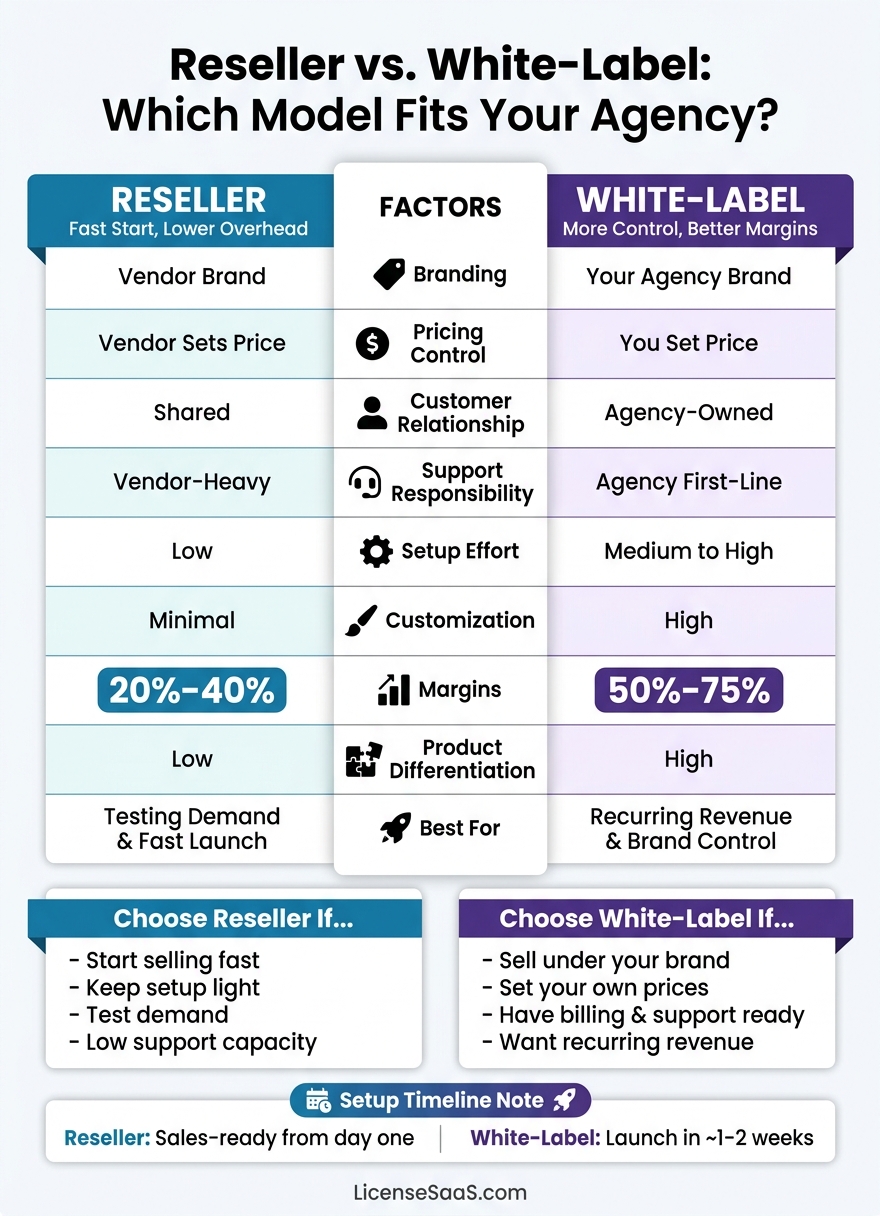
Reseller vs. White-Label: Agency Model Comparison
Complete Guide to White Label Reselling by DashClicks
sbb-itb-8650f75
Quick Comparison
| Factor | Reseller | White-Label |
|---|---|---|
| Branding | Vendor brand | My agency brand |
| Pricing | Vendor-led | I set pricing |
| Customer relationship | Shared | Mostly mine |
| Support | Vendor-heavy, but my team may get first questions | My team handles first-line support |
| Setup | Low | Medium to high |
| Margins | 20%–40% | 50%–75% |
| Customization | Limited | More options |
| Best for | Testing demand and fast launch | Recurring revenue and brand control |
My takeaway: if I don’t have support, billing, and client success covered yet, reseller is often the safer pick. If I do have those pieces in place, white-label can give me more room on price, margin, and brand position.
That’s the lens I’d use before looking at any SEO software, CRM, or marketing automation deals.
How the Reseller Model Works
In a reseller setup, you sell software under the vendor’s name and branding. The vendor runs the product and backend. Your agency handles the sale and the client relationship.
That usually means you earn through a commission or a reseller markup. Margins vary, but the setup itself is pretty simple.
Here’s how ownership and day-to-day responsibility usually break down:
| Responsibility | Agency (Reseller) | Software Provider |
|---|---|---|
| Product Development | No | Yes |
| Infrastructure & Hosting | No | Yes |
| Sales & Marketing | Yes | No |
| Account Management | Yes | No |
| Branding & IP | No | Yes |
| First-Line Support | Often Yes | No |
| Security & Patches | No | Yes |
One thing catches agencies off guard: client questions often hit your team first. So even if you don’t own the product, you still sit at the front of the relationship. That split matters most when you look at speed, margin, and control.
When the Reseller Model Makes Sense
The reseller model makes sense when speed and simplicity matter more than owning the brand. You’re selling something that already exists, already works, and already has support behind it. That makes it a fast way to add software to your service mix.
The downside is control. You don’t set the pricing, so your margins are limited by what the vendor allows. You also can’t put your own brand on the product. And if the vendor shifts pricing or changes product direction, your clients feel that too.
Still, for agencies that want to test a software offer without taking on a heavy build, this can be a smart place to start. Lower overhead, a faster launch, and a product that’s already in the market can make the choice pretty straightforward when you’re still figuring out whether software belongs in your agency. That tradeoff becomes even clearer in actual agency use cases.
Agency Examples: SEO, CRM, and Marketing Automation
The reseller model fits agencies that want software revenue without owning the product.
For example:
- A digital marketing agency might resell vendor-branded SEO software as an add-on to its strategy work.
- A full-service agency might bundle vendor-branded CRM software into a monthly retainer.
- An agency running email campaigns might resell a marketing automation platform while putting its value on execution, not the tool itself.
White-label shifts that balance by giving the agency more control over branding and pricing.
How the White-Label Model Works
With white-label software, you license a platform and sell it under your agency brand. Your logo, colors, and domain take the place of the vendor’s branding, so clients see your agency identity the whole time.
And it usually goes well beyond a simple logo change.
In many cases, agencies can tailor the client portal, use a branded subdomain like app.brand.com, send email from a custom address, apply branded templates, and publish their own Terms of Service and Privacy Policy. Some platforms also let agencies publish app-store listings through their own developer account [1].
| Rebrandable Category | What's Typically Included |
|---|---|
| Branding | Logo, colors, favicon, typography |
| Domain | Custom subdomain, SSL certificate |
| Communication | Custom email sender, branded templates |
| Legal & Support | Terms of Service, Privacy Policy, help center, support contact |
| Reporting | Branded analytics dashboards, client-facing reports |
That’s the big draw here. Instead of sending clients to someone else’s product, you can offer software that feels like part of your own business.
What Agencies Gain and What They Take On
The biggest upside is margin and pricing control. White-label deals often land in the 50–75% margin range, while a standard reseller setup is more likely to sit around 20–40%. You also keep control of the client relationship, and that brand ownership can make the agency itself worth more over time [1].
The flip side is simple: this model asks more from you. Setup takes more work. Day-to-day admin usually takes more work too. So while the upside is higher, the lift is heavier than it is with a reseller model.
Agency Examples: Branded Software Offers
A growth agency might license a white-label reporting platform and deliver it through a branded client portal.
A managed services agency could bundle white-label CRM software and add recurring software revenue on top of existing fees.
For digital agencies, that can mean adding $50–$500 per client, per month in recurring revenue by white-labeling tools [1]. Pair that with full brand control, and it’s easy to see why agencies that want more ownership and a sharper market position often pick this route over reselling.
Reseller vs. White-Label: A Direct Comparison
Reselling is about simplicity. White-labeling is about control.
That’s the core tradeoff. One gets you to market fast. The other gives you more say over branding, pricing, and the client relationship.
Here’s how the two models compare on the things that shape launch speed, control, and profit:
| Factor | Reseller | White-Label |
|---|---|---|
| Brand Visibility | Vendor-branded | Agency-branded |
| Pricing Control | Vendor sets price | Agency sets price |
| Customer Relationship | Shared | Agency-owned |
| Support Responsibility | Vendor support | Agency first-line support |
| Setup Effort | Low - sales-ready from day one | Medium to high - branding, domains, and billing |
| Customization | Minimal | High |
| Revenue Model | Commission or fixed margin | Subscription markup |
| Delivery Risk | Low - vendor manages the tech | Higher - agency manages the client experience |
| Product Differentiation | Low - same product as other resellers | High - positioned as proprietary offer |
The table makes the structural gap pretty clear. But structure alone doesn’t tell you what you’ll keep.
Gross margin is not net margin. That part trips people up all the time. You also need to factor in onboarding, support, billing, processing fees, and churn. A model can look great on paper and still feel tight once day-to-day costs hit.
Matching Each Model to Your Agency Goals
Once you can see the tradeoffs, the next step is simple: match the model to what your agency needs right now.
- Reseller: Pick this if you want to launch fast, keep overhead low, and test demand.
- White-label: Pick this if you want recurring revenue, control over branding, and a more differentiated offer.
A Quick Readiness Check Before You Decide
Before you commit, run a quick pressure test. It helps you spot weak points before they turn into expensive problems.
- Do you own the customer relationship, or does the vendor?
- Can your team handle first-line support without slowing delivery?
- Do you already have a recurring billing process in place - or the budget to build one?
- Can you absorb a minimum monthly platform cost during slower months?
- Does your offer need a branded portal or custom reporting layer to stay competitive?
- Have you modeled your margins using real U.S. dollar operating costs, not just the headline percentage?
If most of those answers are yes, white-label may be within reach. If several answers are still shaky, a reseller setup gives you room to start selling while you put the back-end pieces in place.
Finding and Licensing the Right Model Through LicenseSaaS
Once you've finished the readiness check and picked a model, the next move is simple: find a product you can license.
That’s where LicenseSaaS comes in. It helps agencies source and license a fit by letting you filter listings by deal type, post buyer requests, and get matched with sellers automatically. In plain English, it helps you cut through the clutter and look for deals that line up with the level of control and support your agency can handle.
From there, the job shifts from finding a deal to checking the terms that affect margin, control, and launch time.
Before you commit, review the contract closely. LicenseSaaS includes secure deal rooms, escrow, and code verification after signing, before deployment, to reduce deal risk. White-label deals can launch in 1–2 weeks; general licensing deals usually take 2–4 weeks [1].
What to Confirm Before Signing a Reseller or White-Label Deal
The deal-type filter helps you find the right bucket. But the fine print is what tells you whether the deal will work in practice for your agency.
For reseller deals, check these points before signing:
- Resale rights - are they exclusive or non-exclusive in your market?
- Pricing rules - does the vendor set a floor, or can you price freely?
- Branding limits - can you co-brand, or does the vendor's logo stay front and center?
- Support obligations - who handles tickets, and what's the SLA?
For white-label deals, the focus shifts more toward ownership and scope:
- Rebranding permissions - full rebrand, co-brand, or API/headless only?
- Customer ownership - are your client relationships yours, or does the vendor retain data rights?
- Deployment scope - how many client accounts or seats does the license cover?
- Maintenance responsibility - who handles updates, patches, and uptime?
- Commercial terms - are there minimum monthly fees, usage caps, or revenue share clauses?
LicenseSaaS also helps on the execution side. It offers draft agreements ready for review, direct founder contact so you can clear up terms fast, and AI license compliance tools that automate audits and renewal tracking after the deal is signed [1]. For more involved white-label deployments, concierge deployment can speed launch [1].
Conclusion: Choose Based on Control, Margin, and Capacity
After the terms check, the decision comes down to what your agency can support right now.
If speed matters most, go with reseller. If brand ownership and better margins matter more, go with white-label.
The smart move is to start with what your team can execute well today, then build from there based on your support capacity, billing setup, and branding needs.
FAQs
Which model is easier for a small agency to manage?
For a small agency, the reseller model is often easier to run because it takes less setup and comes with fewer day-to-day responsibilities.
You’re acting as a sales channel for the vendor, which means you can skip extra work like setting up custom domains, building separate billing systems, and handling the first-line support that often comes with white-labeling.
How do support responsibilities change with white-label?
In a white-label model, support mostly moves to the agency.
Because the end client only sees your brand, your team usually handles first-line support and, in many cases, second-line support too. The vendor, meanwhile, takes care of the platform behind the scenes: infrastructure, security, and core product development.
That split sounds simple on paper. In practice, it can get messy fast if no one spells out who owns what.
Before launch, lock down support boundaries in your agreement. Be clear about:
- when your team handles an issue and when it gets escalated to the vendor
- what access you get to the vendor for escalations
- the SLA terms for bug fixes
- who is responsible for technical outages
If those details are fuzzy, small support issues can turn into finger-pointing the moment something breaks.
When should I switch from reseller to white-label?
Consider switching when you want to build a business you can sell more easily instead of staying in the middle as an intermediary. Reselling is easier to start, but it keeps you tied to the vendor’s brand and pricing.
Move to white-label when you’re ready to own the customer relationship, control branding, set your own pricing, and stand out through custom configurations, onboarding playbooks, or managed services.