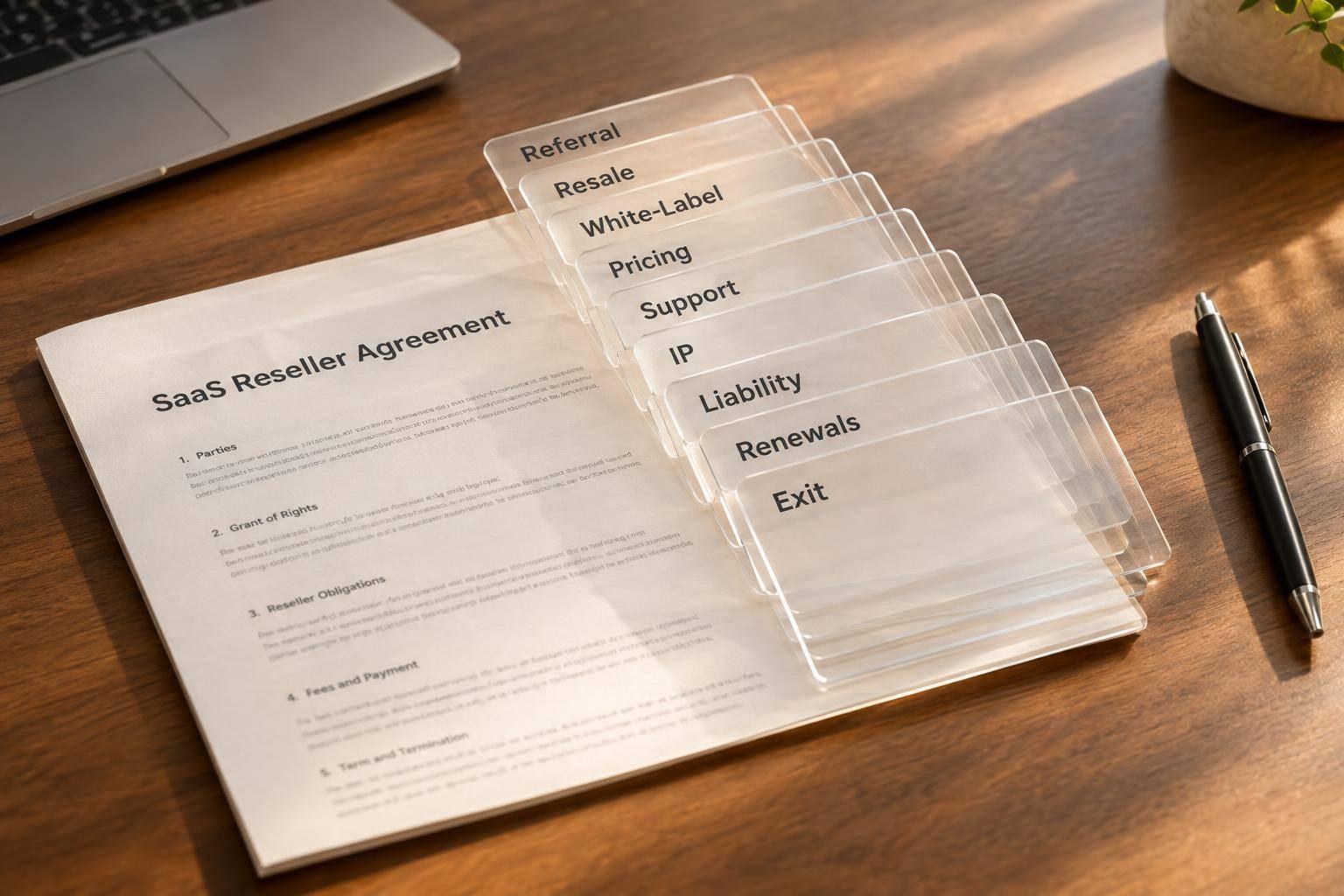
The Ultimate Guide to SaaS Reseller Agreements
Before you sign a SaaS reseller agreement, define who sells, bills, supports, renews, and bears the risk. I start with 3 rights models: referral, resale, and resale with white-label rights. Permission to sell does not automatically include permission to rebrand or sublicense.
Here’s what I check:
- Sales rights: Products, territories, channels, exclusivity, and branding.
- Money and accounts: Margins, payment deadlines, customer contracts, account access, and renewals.
- Support and risk: Service levels, software ownership, privacy duties, warranties, indemnities, and liability caps.
- Exit terms: Termination, customer handoffs, refunds, data exports, and duties that survive the agreement.
My rule: <u>match your customer promises to the vendor’s commitments</u>. Record the agreed terms - including in LicenseSaaS if you use it - and have qualified U.S. counsel review them. Verify product, cost, and revenue claims before signing.
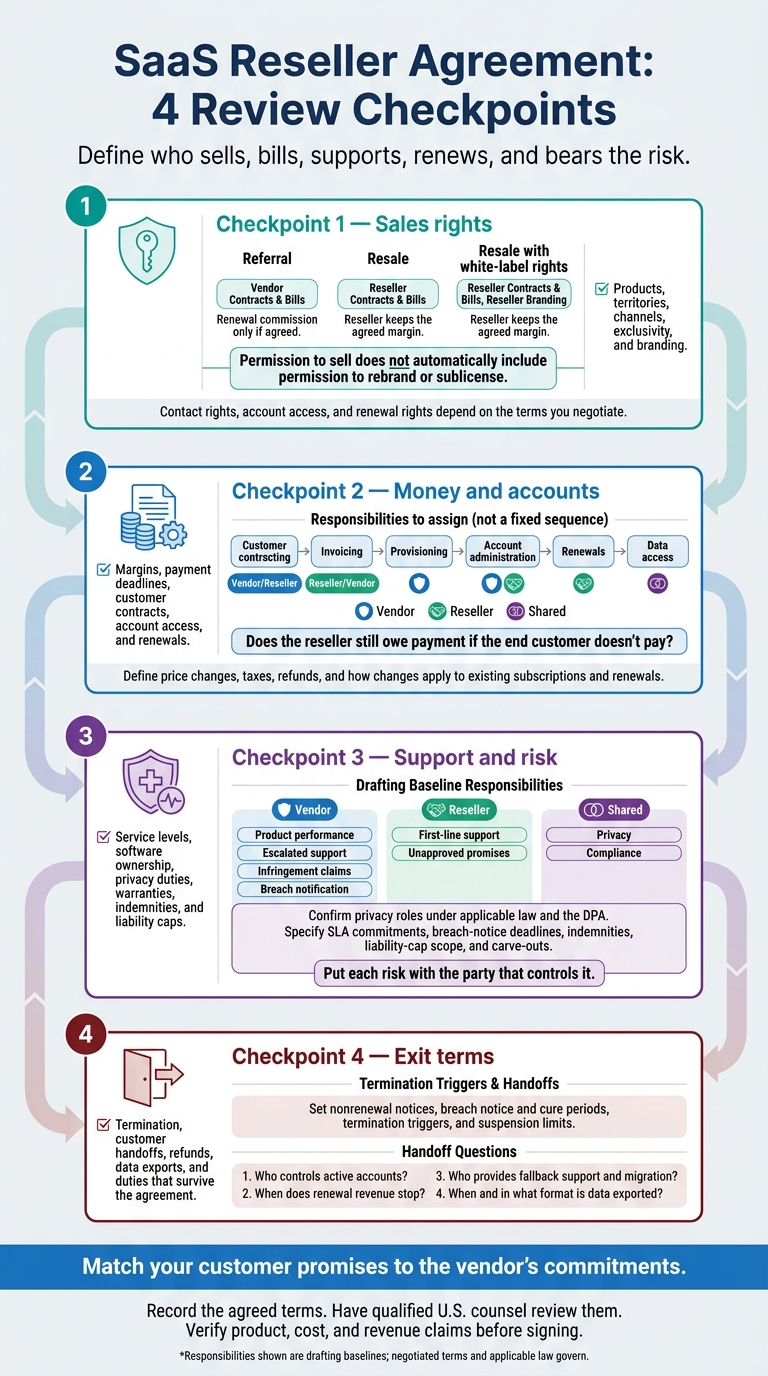
SaaS Reseller Agreement: 4 Review Checkpoints
How Software Reseller Agreements Boost SaaS Growth and Protect Your Business
sbb-itb-8650f75
Choosing Referral, Resale, or White-Label Rights
White label vs SaaS licensing models differ in how they handle distribution and branding and can be added to resale rights.[1][3] Neither label determines who controls the customer relationship. Contact rights, account access, and renewal rights depend on the terms you negotiate.
Use the comparison below to choose your commercial model.
| Term | Referral | Resale | Resale with white-label rights |
|---|---|---|---|
| Customer contracts | Vendor and end customer | Reseller and end customer | Reseller and end customer |
| Invoicing | Vendor bills customer | Reseller bills customer | Reseller bills customer |
| Pricing control | Vendor sets prices | Reseller sets prices within agreed limits | Reseller sets prices, often with full control |
| Branding | Vendor branding | Vendor branding or co-branding | Reseller branding |
| Support | Vendor generally handles support | Tiered responsibilities between reseller and vendor | Tiered responsibilities between reseller and vendor |
| IP rights | Vendor retains core IP | Vendor retains core IP; sublicensing only if expressly allowed | Vendor retains core IP; rebranding is licensed |
| Renewal revenue | Commission only if agreed | Reseller keeps the agreed margin | Reseller keeps the agreed margin |
Referral Fees and Lead Registration
Spell out how leads are submitted, accepted, and attributed. Cover duplicate leads and how long registration protection lasts. State when commissions become payable and whether renewals qualify.
For revenue sharing, define collected revenue, not just booked sales, and explain how refunds affect payments. The vendor generally contracts with and bills customers. Set limits on the referrer’s authority to promise discounts, warranties, or service commitments.
Resale Rights and Sales Limits
Specify which products, editions, APIs, and uses the agreement covers. Then define the territories, customer segments, and sales channels where the reseller can sell.
Address exclusivity, minimum commitments, deal registration, and accounts reserved for the vendor. State whether sub-resellers are allowed, along with any approval requirements, reporting duties, or restrictions they must follow.
White-Label Branding and Disclosures
White-label rights let resellers remove the original branding and use their own brand, typically with their logo on their domain.[1] Specify any vendor disclosures required in legal terms, support flows, or customer notices.
With the rights model set, define pricing, billing, and account control.
Pricing, Orders, and Customer Account Control
These clauses set out who bills, who collects payment, and who controls the customer account after the sale.
Margins, Discounts, and Payment Terms
Attach the wholesale price schedule. Define resale margins, discount tiers, invoice timing, and payment obligations.
Specify who invoices the customer and collects payment, along with how the agreement handles price increases, taxes, refunds, and customer nonpayment. Be explicit about whether the reseller still owes payment if the end customer doesn’t pay.
Explain how price changes apply to existing SaaS license models and renewals.
Orders, Account Setup, and Renewals
Define who approves orders, sets up subscriptions through the vendor or reseller portal or API, and manages renewals. Explain how seat changes, plan changes, and cancellations are processed, including how proration works.
Customer Contracts, Contact Rights, and Access
Use the following allocation as your drafting baseline.
| Control point | Terms to specify |
|---|---|
| Provisioning | Portal or API permissions and activation requirements |
| Account administration | Administrator roles and rights to contact customers |
| Renewals workflow | Notice deadlines and required approvals |
| Data access control | Access permissions and authority to grant or revoke access |
Explicitly assign responsibility and authority for customer contracting, invoicing, provisioning, renewals, branding, support, and data access.
Align these control points with the support, IP, and liability clauses that follow.
Support, IP, and Risk Allocation
Once pricing and account control are set, assign support, IP, privacy, and liability duties to match. Put each risk with the party that controls it. Use this matrix as a drafting baseline, then check it against actual support workflows and customer commitments.
| Duty | Primary responsibility | Shared duties and limits |
|---|---|---|
| Product performance | Vendor | Uptime and bug fixes follow the SLA. |
| First-line support | Reseller | Handles basic end-customer issues. |
| Escalated support | Vendor | Handles bugs and infrastructure issues. |
| Privacy | Shared | Reseller acts as controller/business; vendor acts as processor/service provider under the DPA. |
| Infringement claims | Vendor | Controls the defense of core software claims. |
| Unapproved promises | Reseller | Responsible for customer promises made without approval. |
| Breach notification | Vendor | Set a firm notice deadline. |
| Compliance | Shared | Separate software compliance from reseller-specific tax, licensing, and industry rules. |
The clauses below turn these assignments into rules each party can follow.
Support Duties and Service Levels
Make the reseller responsible for first-line support and the vendor responsible for escalations. Tie response times and resolution targets to the SLA.
IP Rights, Confidentiality, and Data Protection
Keep the vendor’s ownership of the codebase separate from any rights expressly granted to the reseller to rebrand, distribute, or sublicense.
In the DPA, define who handles and processes customer data. Confirm each party’s role under applicable U.S. privacy laws, and state who sends breach notices and by what deadline.
Warranties, Indemnities, and Liability Caps
Define the vendor’s warranties for the software and the reseller’s warranties for its conduct and approved representations. Use the reps-and-warranties clause to assign responsibility for fixing issues caused by unsupported reseller promises.
Specify IP and data-related indemnities, including who controls the defense, how the parties must cooperate, and who approves settlements.
Make the liability caps explicit: do they apply per claim or in aggregate? State which damages are excluded and which obligations have carve-outs or separate caps. Match the caps to customer commitments so the reseller does not absorb losses it cannot recover. Align these limits with termination and customer-transition rights.
Ending and Reviewing the Agreement
Once pricing, support, and risk are settled, the agreement also needs to spell out how the relationship ends.
Termination and Customer Transition
Set the agreement’s term, nonrenewal notice requirements, breach notice and cure periods, immediate termination triggers, and suspension limits. Make clear who controls active customer accounts after termination, when renewal revenue stops, and who handles refunds.
Assign fallback support and migration duties if the reseller doesn’t respond. Include a deadline for exporting data and the required format. State which payment, confidentiality, and other duties continue after termination.
Use the checklist below to check that the exit terms fit the commercial structure above.
Agreement Review Checklist
Before signing, check the remaining deal-specific terms: scope, sublicensing authority, field-of-use limits, exclusivity, audit rights, price escalation, assignment, and change-of-control rights.
Bring in legal counsel if the terms involve exclusivity, regulated data, high liability exposure, source-code access, or unusual transition rights, such as escrow or insolvency provisions. Record the final terms in one place before execution.
Preparing an Agreement with LicenseSaaS
Use LicenseSaaS to record the agreed terms. The agreement still needs legal review, and buyers must independently verify technical, cost, and revenue claims before signing [2][1].
FAQs
How can I protect my margins at renewal?
Negotiate pricing protections upfront in your licensing agreement so vendor price increases don’t squeeze your margins [1].
Set annual rate caps, such as 5%–10% or a cap tied to the Consumer Price Index, and require at least 90 days’ notice before pricing changes [1]. Include volume-based per-seat pricing as your client base grows [2], plus contractual rights to export client data if price hikes become too costly and force you to migrate [1][2].
What if the vendor’s SLA falls short of my customer promises?
If your vendor’s service-level agreement (SLA) doesn’t meet the uptime you promise customers, you’re responsible for the gap. As their main point of contact, you need to manage the risk when those commitments don’t line up.
Negotiate an SLA that meets or exceeds your customer commitments. Your contract should also let you pass vendor service credits on to customers without that counting as an admission of liability.
How can I protect customers if the vendor shuts down?
Before you sign, negotiate specific continuity terms. The strongest safeguard is source-code escrow: if the vendor becomes insolvent, the software code is released to you so you can keep the service running during a transition.
Also require a defined data-portability window, typically 30 to 90 days, to export customer data in machine-readable formats such as CSV or JSON. Set clear discontinuation notice periods, too, so you have enough time to migrate customers.